Roma Capitale
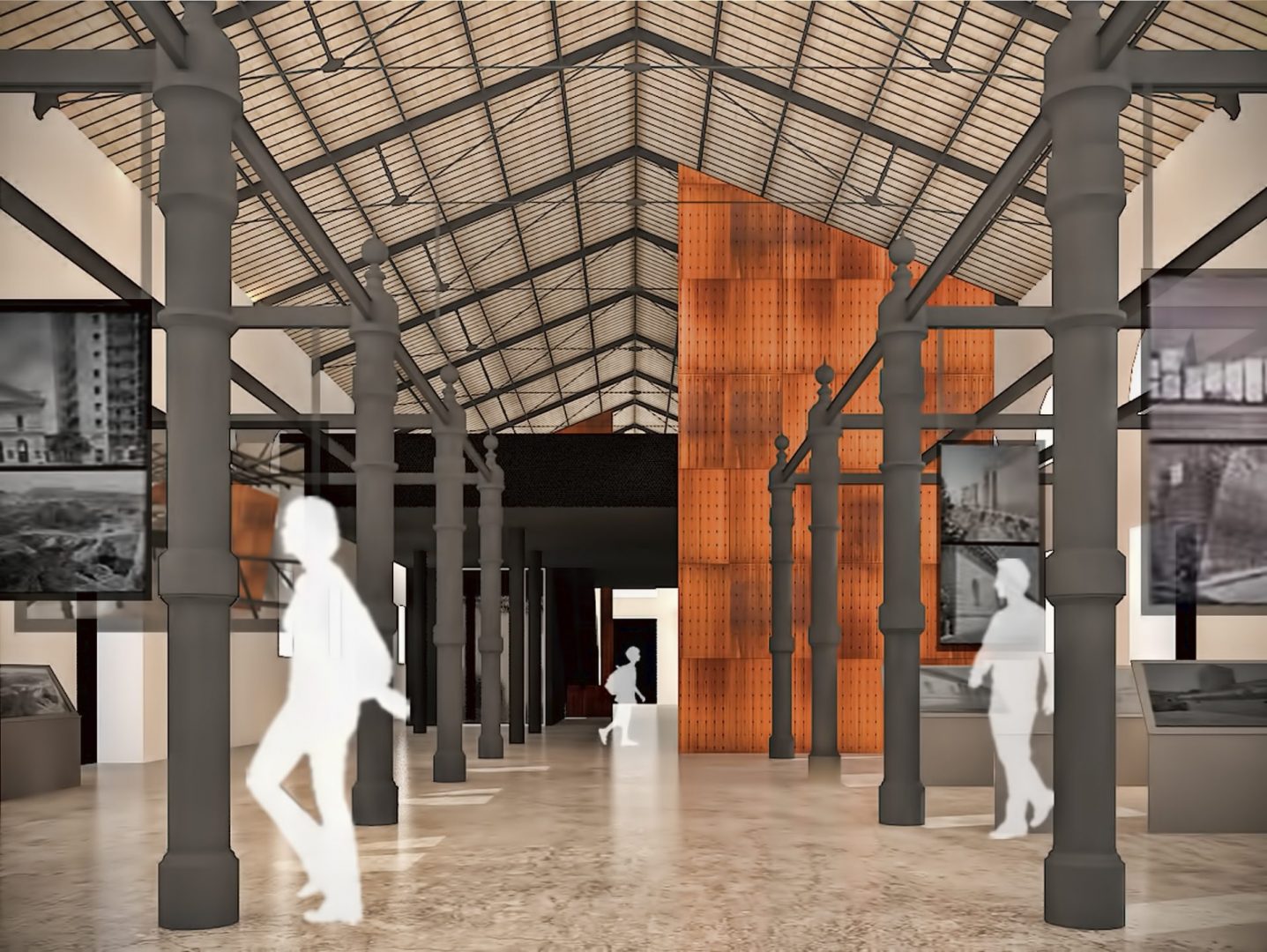
Render ex Mattatoio

CULTURE

Caput Mundi: restoration and renovation of pavilion 3a, with its terrace overlooking pavilion 3d and pavilion 3c of the Ex Mattatoio of Testaccio

The Mattatoio (slaughterhouse) is located in an area of considerable archaeological importance that once housed commercial and residential structures. The main building, designed by Gioacchino Ersoch and built between 1888 and 1891, originally served as the slaughterhouse and cattle market.

The Pavilions are located near the eastern perimeter edge of the complex and were originally used for blood processing.

The complex consists of three main parts: a two-storey central building with a four-pitch roof, a one-storey side building with an accessible flat roof, and another building that can only be reached from the terrace. Currently, the ground floor of the building houses the offices of the Capitoline Superintendence, while the upper floor, previously used as a residence for the slaughterhouse staff, is now unused and requires renovation.

The buildings show signs of decay due to the age of the construction and their state of neglect, although they are overall intact. The project aims at redevelopment and conservative restoration, aimed at the renovation and opening up to new activities.

Within the overall framework of the restoration of the Ex-Mattatoio di Testaccio monumental complex, the project will have the following objectives: 

  • recover the original appearance of the Pavilions, as conceived by the architect Gioacchino Ersoch;
  • make evident the traces left by the transformations the Pavilions have undergone over time; 
  • reconcile the new requirements of functionality with the legibility of an industrial archaeology artefact of primary importance.

Roma Capitale
Cultura

CULTURE

Caput Mundi: restoration and renovation of pavilions, 27a-28b of the Ex Mattatoio of Testaccio

The Mattatoio (slaughterhouse) is located in an area of considerable archaeological importance that once housed commercial and residential structures. The main building, designed by Gioacchino Ersoch and built between 1888 and 1891, originally served as the slaughterhouse and cattle market.

The Pavilions are located along the eastern perimeter of the former slaughterhouse complex and were originally used as stables (27a and 2a, part) and entrance (28b).

Pavillion 27a has a very elongated rectangular shape, with a height of approximately 6m and a double-pitched roof. The structure is in a state of total abandonment and part of the roof was destroyed by a recent fire.

 Pavilion 28b has a practicable flat roof and consists of two covered side bays that allow the entrance to the Campo Boario, as well as three closed central rooms, formerly used as the guardhouse. Pavilion 2a corresponds to the portion of a rectangular building along the Piazza Giustiniani façade. It has a double-pitched roof, formerly occupied by a discotheque, and is currently in a state of disrepair. One of the buildings houses a depository of Monte dei Cocci artefacts.

Within the overall framework of the restoration of the Ex-Mattatoio di Testaccio monumental complex, the project will have the following objectives:

  • recover the original appearance of the Pavilions;
  • make evident the traces left by the transformations that the Pavilions have undergone over time;
  • reconcile the new requirements of functionality with the legibility of an industrial archaeology artefact of primary importance.

Roma Capitale
Cultura

CULTURE

Caput Mundi: Redevelopment of the public spaces pertaining to the former slaughterhouse of Testaccio (external parking area Via di Monte Testaccio/Ferrovia and completion of internal areas)

The slaughterhouse is located in an area of considerable archaeological importance that once housed commercial and residential structures. The main building, designed by Gioacchino Ersoch and built between 1888 and 1891, originally served as the slaughterhouse and cattle market.

The project focuses on the creation of public spaces, including car parks, pedestrian areas and green spaces. At present, much of the area is in a state of neglect, with unpaved land and uncultivated vegetation. 

The redevelopment activities include the construction of parking spaces outside the former slaughterhouse between Via della Pelanda and Via di Monte Testaccio, as well as a car park between the Aurelian Walls and the southern boundary of the slaughterhouse complex. In addition, the restoration of internal pedestrian areas will be completed and a new street lighting system will be installed.

The main objective of the intervention is to make the area accessible and usable, meeting the need to provide public parking and green spaces, therefore contributing to the overall improvement of the area.

Roma Capitale
Cultura

CULTURE

Caput Mundi: Restoration of the entrance façade and east and west perimeter walls of the former slaughterhouse; restoration of the entrance façade and perimeter wall of the Campo Boario

The project concerns the conservative restoration and enhancement of the façades of the former slaughterhouse and the Campo Boario, including the monumental entrances. Currently, these façades show signs of degradation due to their state of neglect. Restoration activities will be conducted in a philological manner, following the original design. The layers in good condition will be maintained and the consolidation of the superficially damaged parts will be carried out with compatible materials.

Artistic lighting will be provided to highlight the monumental entrance with the sculptural group of the Tauromachia, therefore contributing to the aesthetic enhancement of the area.

Roma Capitale
Cultura

CULTURE

Caput Mundi: Aurelian Walls tract Porta Latina-Porta Metronia

The section needs conservative restoration work to stop the mortar flaking off, the detachment of the face, the disintegration of the wall ridges and the presence of cracks/lesions due to infesting vegetation and deep root systems. Structural work will be carried out to restore the stability of several wall structures and the artistic and functional lighting system. Access to the walkway beside Porta Metronia and the patrol path will be restored.

The following works are planned for the realisation of the project:

  • preliminary cleaning operations;
  • elimination of infesting vegetation and biological attacks;
  • conservation works;
  • constitutive reinforcement works;
  • construction of an electrical and lighting system;
  • adaptation to legislation on architectural barriers, safety, fire prevention.
Roma Capitale
Cultura

CULTURE

Caput Mundi: Conservative restoration and enhancement of the Aurelian Walls section Piazza S.Giovanni - Piazza di Santa Croce in Gerusalemme

The restoration of the Aurelian Walls, in the section stretching from the Basilica of San Giovanni in Laterano to Piazza di Santa Croce in Gerusalemme, represents a significant step forward in the enhancement of Rome’s historical and cultural heritage.

The intervention not only aims to preserve the historical integrity of the walls, but will also improve accessibility and the visitor experience along the walking paths toward Porta Asinaria, which is made in gravel. The accessible outdoor areas will be expanded, with the creation of a garden area. Furthermore, the walkway along Via Carlo Felice, which has so far been closed to the public, will be safely opened. 

The new paving will be made of cocciopesto (building material used in ancient Rome), laid over an aluminum fiber sheet and prepared for a floating installation. This non-invasive dry system allows for the organization of utility lines beneath the floor, ensuring easy maintenance while concealing connections. 

Additional works are planned to improve access to the towers and internal areas of Porta Asinaria, including lighting installations—both standard and emergency—and handrails. The goal is to offer a richer visitor experience while respecting the site's historical integrity and ensuring the safety and sustainability of the new structures.

Roma Capitale
Cultura

CULTURE

Caput Mundi: Aurelian Walls section viale del Policlinico/British Embassy

On the portion of the British Embassy's perimeter wall, there was a major collapse involving the detachment of the curtain wall and the parapet of the wall-walk. Provisional works are currently being carried out to secure the span and the buttress towards Via XX Settembre.

The section needs conservative restoration work to stop the mortar flaking off, the detachment of the face, the disintegration of the wall ridges and the presence of cracks/lesions due to infesting vegetation and deep root systems. Structural work will be carried out to restore the stability of several wall structures and the artistic and functional lighting system.

Specifically, the following works and projects are planned:

  • preliminary cleaning operations;
  • elimination of infesting vegetation and biological attacks;
  • conservation works;
  • constitutive reinforcement works;
  • structural reinforcement;
  • restoration or replacement of flooring;

waterproofing of walkways and all horizontal surfaces.

Roma Capitale
Cultura

CULTURE

Caput Mundi: Aurelian Walls tract Via Campania/Corso d'Italia

The section needs conservative restoration work to stop the mortar flaking off, the detachment of the face, the disintegration of the wall ridges and the presence of cracks/lesions due to infesting vegetation and deep root systems. Structural work will be carried out to restore the stability of several wall structures and the artistic and functional lighting system.

Specifically, the project includes the following works:

  • preliminary cleaning operations;
  • elimination of infesting vegetation and biological attacks;
  • conservation works;
  • constitutive reinforcement works;
  • structural reinforcement;
  • construction of an electrical and lighting system;

adaptation to legislation on architectural barriers, safety and fire prevention.

Roma Capitale
Sostenibilità

SUSTAINABILITY

Caput Mundi: Aurelian Walls section from Porta S. Paolo to the Tiber

The section of the Aurelian Walls between Porta San Paolo and the Tiber River is undergoing a significant conservative restoration, structural consolidation, and enhancement project.

A comprehensive campaign of structural, material, and geological investigations, combined with a detailed visual analysis, has revealed numerous issues, both structural and related to preservation. 
In addition to specific structural imbalances, conservation problems have emerged, linked to the deterioration of materials and the presence of weedy vegetation. These factors negatively affect the safety, preservation, and readability of the structure.

The works currently in progress include:

  • securing the structure with temporary steel supports and polyester straps;
  • consolidating the foundations through injections of expanding resins and the construction of reinforced concrete curbs;
  • structural interventions on the upper portions with active metal ties to counteract the thrust of the vaults;
  • cleaning and restoring stone and plastered surfaces using compatible, reversible, and low-visual-impact treatments;
  • removing the existing bituminous membrane and resurfacing the walkway using cocciopesto (building material used in ancient Rome);
  • removing of weedy vegetation and deep root systems.

The interventions aim to restore the stability and integrity of this monumental complex, safeguarding its historical, architectural, and cultural value for future generations.

Roma Capitale
Cultura

CULTURE

Caput Mundi: Aurelian Walls section Porta Latina - Porta S. Sebastiano

The section needs conservative restoration work to stop the mortar flaking off, the detachment of the face, the disintegration of the wall ridges and the presence of cracks/lesions due to infesting vegetation and deep root systems. Structural work will be carried out to restore the stability of several wall structures and the artistic and functional lighting system.

Specifically, the following works and projects are planned:

  • preliminary cleaning operations;
  • elimination of infesting vegetation and biological attacks;
  • conservation works; 
  • constitutive and structural reinforcement;
  • construction of electrical and lighting systems;
  • adaptation to legislation on architectural barriers, safety, fire prevention.